Top Nav Menu

Archive | Uncategorized

New OSHA Rule Affects Post Accident Drug Testing

New OSHA Rule Affects Post Accident Drug Testing

injury form

Effective January 1st 2017, non-federally regulated employers need to ensure that they perform post-accident drug testing only in “situations in which employee drug use is likely to have contributed to the incident, and for which the drug test can accurately identify impairment caused by drug use.”  This, according to the “Improve Tracking of Workplace Injuries and Illnesses” OSHA final ruling.

Employers may need to update their drug testing policies that allow for blanket requirements that require drug testing be performed for any workplace accident. The ruling does not explicitly prohibit post-accident testing, rather, to ensure that post accident testing occurs only when the employer believes that impairment may have been a factor. The obvious problem with this type ruling is that it places employers in the sticky situation of having to determine when drug use would have “likely” been a factor in an accident. Employers need not specifically suspect drug or alcohol use or impairment before testing, but there should be a reasonable possibility that use by the reporting employee was a contributing factor to the reported injury or illness in order for an employer to require drug testing.

One can speculate that the new OSHA law’s intent is to remove the use of post-accident drug testing as a punishment for employees involved in workplace accidents. OSHA provided examples of scenarios where employers should not perform drug testing:

“it would likely not be reasonable to drug-test an employee who reports a bee sting, a repetitive strain injury, or an injury caused by a lack of machine guarding or a machine or tool malfunction. Such a policy is likely only to deter reporting without contributing to the employer’s understanding of why the injury occurred, or in any other way contributing to workplace safety.”

No Change for Federal Testing

For federally regulated testing, employers should continue to perform post-accident testing as required by DOT regulations. Since federal law requires post-accident testing, it would not be considered to be performed in a retaliatory manner. However, most federally regulated companies also have general “non-DOT” drug free workplace policies where this ruling would apply.

What can employers do?

  • Train supervisors to spot the sign and symptoms of drug use or abuse. All supervisors should have a basic knowledge on how to spot the signs and symptoms of drug use and abuse. Nearly all modern drug testing policies allow for reasonable suspicion drug and alcohol testing, but just having the provision in your policy is not going to prevent accidents. Having supervisors who can spot the signs and symptoms of drug use can help prevent accidents from happening in the first place. We happen to know of a good online program *wink, wink*  that can makes training your entire workforce a pretty easy task.
  • Update your drug and alcohol policy and ensure supervisors and employees have reviewed it. It’s more important than ever to ensure that your drug testing policy is up to date. Drug testing positivity rates have risen in the last two years and state laws have been rapidly changing largely due to a more relaxed sentiment about marijuana use. Chances are your drug testing policy has not been touched since it was originally drawn up. The Current Consulting Group can be a great place to get assistance if needed.
  • Consult your legal counsel. As always, it can be a good idea to chat up your legal counsel whenever changes like these occur.
  • Stay Updated. OSHA keeps a running list of changes that employers can check in on here

FMCSA Declares Trucker Imminent Hazard for Alcohol-Related Crash

FMCSA Declares Trucker Imminent Hazard for Alcohol-Related Crash


ROCKLAND, TN — The Federal Motor Carrier Safety Administration declared a Tennessee-licensed driver to be an imminent hazard to public safety after reckless driving behavior, related to alcohol consumption, led to two deaths.

The Federal Motor Carrier Safety Administration (FMCSA) declared a Tennessee-licensed driver to be an imminent hazard to public safety after reckless driving behavior, related to alcohol consumption. The accident led to the deaths of two motorists.

Randall J. Weddle, driving a truck for R&E Logistics on Route 17 in Knox County, Maine, when his rig crossed the centerline, tipped over and began scattering its load of lumber onto the highway. At the time of the crash, Weddle’s truck was traveling around 80 mph in a posted 55-mph zone.

A pickup truck, SUV and minivan were struck by the load of lumber, killing the driver of the pickup truck and the minivan after both vehicles were crushed. Two additional crash victims were airlifted to the hospital.

A field sobriety test conducted on Weddle by Maine State Police detected the presence of alcohol. The police also found a bottle of whiskey in his truck. Investigators also discovered that at the time of the crash, Weddle’s CDL had been revoked by the state of Virginia for a driving while intoxicated conviction.

Investigators further discovered multiple federal hours-of-service violations. Weddle was also found to have taken a family member as an unauthorized passenger on the same trip as the accident, dropping the passenger off shortly before the crash.

“[His] blatant disregard of [federal safety regulations] and continued disregard for the safety of the motoring public demonstrated by these actions substantially increases the likelihood of serious injury or death to you and/or the motoring public,” stated the FMCSA in its out-of-service order.

Weddle may also be subject to civil penalty enforcement proceeding brought by FMCSA for his violation of the agency’s safety rules.

More at FMCSA website here


Purchase and access FMCSA 60/60 DOT Supervisor Reasonable Suspicion Training right now! – Fulfills Compliance for 49 CFR 382.603

credit cards accepted

Click Here To Buy DOT Supervisor Course – $35 or less! Click Here To Buy DOT Employee Drug Awareness Course – $10 or less!

athandtraining.com screenshot

What You Need to Know:

  • 49 CFR 382.603 is the applicable regulation requiring supervisors of commercial motor vehicle drivers who operate vehicles that require a commercial driver license to take 60 minutes of training on the symptoms of alcohol abuse and another 60 minutes of training on the symptoms of controlled substances use (120 minutes in total).  The purpose of this training is to teach supervisors to identify circumstances and indicators that may create reasonable suspicion that a driver is using or under the influence of alcohol or drugs, supporting referral of an employee for testing.  
  • If you operate vehicles that require a CDL on the public roads and you have more than one employee in the company, you are required to get DOT Supervisor Training. To verify if you are subject to the drug and alcohol regulations, please visithttp://www.dot.gov/odapc/am-i-covered
  • Owner-operators are not subject to DOT supervisor training. However, you are still required to register with a consortium for DOT drug and alcohol testing.
  • Employers need to ensure that the required content is made available to all persons designated to supervise drivers. Information can be found at /regulations/drug-alcohol-testing/what-are-my-employee-and-supervisor-training-responsibilities

Cyclist Hit by Marijuana Impaired Driver

Cyclist Hit by Marijuana Impaired Driver

cyclist hit


Criminal charges filed against driver who tested positive for THC. Salt Lake City via KSL News. Driver in an unregistered car and didn’t have insurance just like a regular good-ole’ stand up citizen.


Purchase and access training right now!

credit cards accepted


Click Here To Buy DOT Supervisor Course – $35 or less!

Click Here To Buy DOT Employee Drug Awareness Course – $10 or less!

athandtraining.com screenshot

Course topics – DOT Supervisor Training Online

Intro: The Drug Free Workplace Act of 1988 | Reasonable suspicion training requirements (Regulations overview) | Record keeping | Course learning objectives

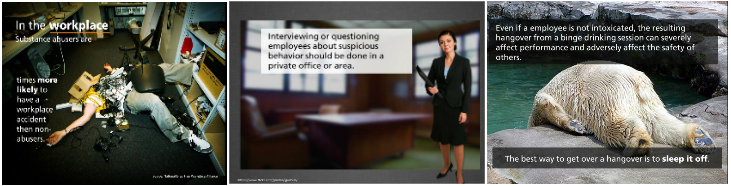
The Big Picture: The effects of substance abuse on society | The effects of substance abuse on the individual and family | The effects of substance abuse in the workplace

Drug Testing: The drug testing process & safeguards | Substance Abuse Professionals | DOT substance testing | Detection times | Refusals

Alcohol Testing:  The alcohol testing process | Evidential breath tests (EBTs) | Breath Alcohol content (BAC)

Drug Classifications & Effects of Use: Depressants | Stimulants | Hallucinogens | Other drugs of abuse (K2/Spice, Bath Salts, etc.)

The Supervisors Role:  Role overview | Confidentiality | Reasonable suspicion testing | Specific, Contemporaneous, articulable definitions w/examples

Common Use Indicators: Identifying abusers | Stereotyping | Physical symptoms | Behavioral  symptoms | Mental symptoms | Job performance | Drug paraphernalia

Intervention: Crisis vs. performance scenarios | Documentation | Enabling | Confrontation and interview | Dos and don’ts | Transportation to the collection site

DOT Supervisor Training Online fulfills:

Federal Motor Carrier Safety Administration (FMCSA) – 49CFR Part 382.603

Federal Aviation Administration (FAA) – 14 CFR Part 121 Append I & J

Federal Transit Administration (FTA) – 49 CFR 655

Pipeline and Hazardous Materials Safety administration (PHMSA)

U.S. Coast Guard (USCG) – §16.250   Reasonable cause testing requirements