Top Nav Menu

Archive | Reasonable Suspicion

DOT Supervisor Training Online

DOT Supervisor Training Online – $37 or less!

Looking for 60/60 drug & alcohol reasonable suspicion DOT supervisor training online?

Look no further. You can fulfill your federal requirements for a single person or your entire organization right here!

Is online training DOT compliant?

Yes. Thousands of companies utilize online training every year to fulfill the 60 minutes drug and 60 minutes alcohol reasonable suspicion supervisor training requirements for FMCSA (trucking) , FAA (aviation), FTA (transportation), USCG, PHMSA (pipeline). See the CFR regulations here.

Why online?

In person training sessions are nice but they can be expensive and hard to coordinate with trainer and employee schedules, or maybe you just need to ensure one or two employees are trained as part of their onboarding process. DVD video courses are typically outdated, poorly produced and just might put your employees into a comatose state. Employees are more likely to surf their smart phone than engage with a video. AtHandTraining’s online course can only be completed if your supervisors are engaged with the content and pass quizzes ensuring they understand the important concepts.

Top 6 benefits of using AtHandTraining’s online course:

#1. Ensure DOT compliance for 60/60 drug and alcohol reasonable suspicion training. Certificates can be generated and training records are stored online.

#2. Employees can access it from anywhere, anytime with any device: iPad, iPhone, Android phone or tablet, PC, MAC- whatever, we have you covered.

#3. Course material updated yearly – new statistics, new drugs, new photos.

#4. Supervisors are quizzed along the way ensuring a basic level of understanding of the key concepts

#5. Administrator access to employee reports

#6. It’s available right now!

Bonus #7. No clip art. Nothing says “made in 1982” like a nice piece of clip art.

Read more

 Who needs this training and how often does DOT require it be taken?

Any supervisor or employee who has the ability to initiate a reasonable suspicion drug or alcohol test and is covered under any of the Department of Transportation agencies FMCSA, FAA, FTA, USCG, PHMSA. Only FAA requires “recurring training every 12-18 months. However, DOT recommends all supervisors re-educate every two years for as best practice. See regulatory requirements for all DOT modes here.

Other online courses run anywhere from $45-$79. Why is AtHandTraining’s course only $37 or less?

Many other providers are piggy backing off of some other learning management system’s (“LMS”) software and must give a kick back to the LMS providers for every course taken. AtHandTraining manages our own system. We simply skipped the middleman.


Purchase and access training right now!

credit cards accepted

Click Here To Buy DOT Supervisor Course – $37 or less!

Click Here To Buy DOT Employee Drug Awareness Course – $10 or less!
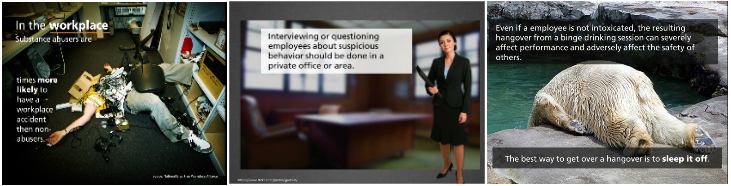
athandtraining.com screenshot

Course topics – DOT Supervisor Training Online

Intro: The Drug Free Workplace Act of 1988 | Reasonable suspicion training requirements (Regulations overview) | Record keeping | Course learning objectives

The Big Picture: The effects of substance abuse on society | The effects of substance abuse on the individual and family | The effects of substance abuse in the workplace

Drug Testing: The drug testing process & safeguards | Substance Abuse Professionals | DOT substance testing | Detection times | Refusals

Alcohol Testing:  The alcohol testing process | Evidential breath tests (EBTs) | Breath Alcohol content (BAC)

Drug Classifications & Effects of Use: Depressants | Stimulants | Hallucinogens | Other drugs of abuse (K2/Spice, Bath Salts, etc.)

The Supervisors Role:  Role overview | Confidentiality | Reasonable suspicion testing | Specific, Contemporaneous, articulable definitions w/examples

Common Use Indicators: Identifying abusers | Stereotyping | Physical symptoms | Behavioral  symptoms | Mental symptoms | Job performance | Drug paraphernalia

Intervention: Crisis vs. performance scenarios | Documentation | Enabling | Confrontation and interview | Dos and don’ts | Transportation to the collection site

DOT Supervisor Training Online fulfills:

Federal Motor Carrier Safety Administration (FMCSA) – 49CFR Part 382.603

Federal Aviation Administration (FAA) – 14 CFR Part 121 Append I & J

Federal Transit Administration (FTA) – 49 CFR 655

Pipeline and Hazardous Materials Safety administration (PHMSA)

U.S. Coast Guard (USCG) – §16.250   Reasonable cause testing requirements

Before you perform that DOT reasonable suspicion drug test

Before you perform that DOT reasonable suspicion drug test – a check list

confused dude


So you have a federally regulated employee you think may be displaying the signs and symptoms of drug or alcohol use while on duty, but you’re concerned about the liability and potential consequences of getting it wrong. What to do? Fear not we’re here to help…

Realize you not only have the right to intervene, but you are required to do so by DOT federal regulations

We won’t cite the specific regulations for each DOT regulatory agency here but know that all DOT CFRs contain language such as “An employer shall require a driver to submit to a controlled substances test when the employer has reasonable suspicion to believe that the driver has violated the prohibitions of subpart B of this part concerning controlled substances.” (example – FMCSA) Notice the language does not say “may require” or “might require”..it states plainly “shall require” and as such if you are reasonable suspicious then you MUST act.

Are you authorized to order reasonable suspicion tests and have you been trained to spot the signs and symptoms?

If you supervise employees who perform safety sensitive duties then you absolutely have the power to initiate reasonable suspicion drug tests, however if you haven’t been formally trained on how to spot the signs or symptoms of substance abuse you should seek the help of another supervisor who has. AtHandTraining.com’s online training can have you qualified and compliant in a few short hours.

Is this a crisis or performance situation?

In the event the employee showing signs and symptoms (blurred vision, loss of balance, slurred speech, violent ro erratic behavior, etc.) then it’s absolutely imperative you remove the employee from performing safety sensitive duties immediately. This is a crisis situation.  There should be no hesitation; the safety of the employee, co-workers and general public is at risk.

If your suspicions are based on things such as showing up late for work, underperformance, excessive risk taking, dramatic behavioral changes or swings, and such then you be working towards building documentation that might lead to a reasonable suspicion test at a later time. This is generally handled by conducting recurring performance reviews and setting performance goals. This allows you the opportunity to both document the history of the employee’s behavior and set performance goals that they agreed to meet. If later, they fail to achieve the goals they agreed to, it creates a stronger case for performing a reasonable suspicion drug test – assuming the signs and symptoms lead you in that direction.

When did you observe the signs and symptoms?

DOT regulations state that in order for observations to be valid they must occur ‘just before, during or just after‘ performing a safety sensitive duty.

Are your observations based on specific, articuaulable and contemporaneous information?

These are the criteria the DOT specifies supervisor observations must meet.

Specific: For ex. Specific would be “Glassy and bloodshot eyes” versus non-specicic “Seemed out of it”.

Articulable: This means you can accurately describe the specific signs or symptoms. For example, you couldn’t say that an employee “associates with the drug abusing type crowd” because there are no specific characteristics that can be described that wouldn’t be based on speculation or stereotypes.

contemporaneous: This means your observations occurred just before, during or after their work period. For example, watching an employee get drunk at a weekend softball game isn’t directly relevant for determining a reasonable suspicion test on a Monday.

Do you need a second supervisor observer?

No. For FMCSA, PHMSHA, FTA, USCG and many FAA organizations, a single supervisor can make the call. If you’re covered by the FAA and have 50 or fewer employees a single supervisor can make the call. FAA covered organizations with more than 50 employees need to have a second supervisor concur. One of the two FAA supervisors must be trained in dot reasonable suspicion signs and symptoms. However always seek a second supervior’s opionion when possible.

The intervention: Interview the employee and keep information confidential

How do you intervene? Simply remove the employee from performing their safety sensitive duty, take them into a private office or other private location (preferably with a second supervisor) and ask them for an explanation of the signs and symptoms you’ve observed. Document their responses. All information should be kept confidential. The goal of the intervention is not to get the employee to admit use, the goal is to simply document the employees responses. Employees might have reasonable explanations for some signs and symptoms, for example red or bloodshot eyes might be the result of severe allergies, but if combined with slurred speech and  loss of balance the explanation no longer holds up.

What if the employee refuses?

You simply need to inform the employee that a refusal to submit to a reasonable suspicion drug test has the same consequences as testing positive. They can refuse, so be prepared to cite your company policy or specific DOT regulations.

What if the employee has proof they have a prescription?

Whether or not an employee has a prescription is irrelevant to a reasonable suspicion drug test. Proceed with the process regardless.

What if the employee admits to use? Is a test still needed?

Yes. The regulations state the employee must submit to a test. There is no “out” for admitting use. They employee could easily change their story later and say they never admitted use.

Do not let the employee escort themselves to the collection site and do not perform the collection yourself

Employees suspect of being under the influence should not be allowed to escort themselves to the collection site and the supervisor making the reasonable suspicion test determination cannot be the person to administer the drug or alcohol test.

Document observations within 24 hours

DOT regulations specify that supervisors need to document their observations within 24 hours. In the event the employee tests positive and challenges you legally or otherwise, proper documentation of your observations will help your cause. Don’t have a checklist? Get one here.

Make sure all documentation is stored in the employee file

The employee might test negative, it’s a real possibility that the employee may actually be under the influence of a substance that 1. Isn’t part of the drug testing panel and therefore wouldn’t be detected (K2, Spice and other newer substances are common examples and 2. The employee hasn’t previously ingested the substance and therefore the body might not have the metabolites present to that would show up in a lab test. For example, if smoked pot for the first time right now and you urine tested them within a few hours, they would be unlikely to test positive whereas if the test occurred in the next day or two they would. Alcohol tests are different because they do not test for past use, rather they can tell whether or not a person is under the influence at that very moment. Documentation of employee behavior can help establish an actionable pattern of negative employee performance even if the employee tests negative.

 Remeber enabling substance abusing employees to get away with their behavior puts everyone’s safety at risk, including the employee who may need help with an addiction and transfers the consequences of their behavior to others

AtHandTraining.com provides awesome online training for DOT Supervisor reasonable suspicion training and for DOT employees for drug and alcohol awareness training.

Buy now and begin training in minutes!

credit cards accepted


Buy DOT Supervisor Course

Buy DOT Employee Drug Awareness Course

Buy DFWP Supervisor Course

Buy FAA Recurring Course

Workplace Drug Testing in the Era of Legal Marijuana – Report Highlights

Workplace Drug Testing in the Era of Legal Marijuana – Highlights

US Map of states with legal marijuana

In March 2015, Robert L. Dupont MD of The Institue of Behavioral Health published an excellent report that all employers managing drug free workplace programs should review. The purpose of the report is to help provide some guidance to employers in an era  of chaning public opinion and fast changing states laws. 

However, if you have a short attention span like we do, it’s nice to have the Cliff’s notes version around. Here’s some of the take aways from that report.

The Challenge

As of May 2015, 23 states have passed medical marijuana laws and 4 states have approved it for use recreationally. This has caused confusion amongst employers, applicants and employees. 

  • Each state has drafted their own laws which may achieve similar results but have important nuanced differences.
  • Drug testing in the U.S. is generally categorized as “Federal” and “non-federal’ testing – with federal testing having different requirements. For example, federal testing mandates testing for marijuana where drug free workplace programs could (at risk) exclude marijuana from their testing.
  • Media regularly publishes pro-legalization drug testing related articles without providing adequate or sometimes no counterpoint comments from important organizations such as the Drug and Alcohol Testing Industry Assoc (DATIA) or American Medical Association (AMA), National Institute of Health (NIH), Department of Transportation (DOT) and other agencies.

 The Threat

Legalizing marijuana for medical or recreational purposes does not eliminate the risks it presents to safety or to a company’s bottom line. 

  • Marijuana is a psychoactive drug / mild hallucinogen
  • Marijuana is addictive to about 9% of users
  • Marijuana may increase a users vunderability to stroke
  • Even when “smoked marijuana” is provided for medical purposes is not provided using standard “dosage” standards like it is when provided as Marinol®
  • Short-term effects of marijuana use include impaired short-term memory, impaired motor coordination, altered judgment and, in high doses, paranoia and psychosis
  • There is a strong association between marijuana use and diminished lifetime achievement; motor vehicle crashes; and symptoms of chronic bronchitis

Further legalization of marijuana for medical and recreational use normalizes the use of marijuana implying to many people that its use is safe.

 The Impact of State Based Marijuana on Workplace Drug Testing

Washington DC and 23 other states have approved marijuana for medical use despite it not having been through clinical research  trials, having FDA approval or even being removed form Schedule I status. Regardless it is now seen by the public as medicine. Four states have legalized it for recreational use – directly conflicting with federal law. Some employers are now opting to remove marijuana from their testing program or are treating it as a substance with legitimate medical explaination meaning a laboratory positive could be overturned by a medical review officer if a doctor patient relationship can be verified.

The marijuana positivity rates increased 20 percent in Colorado and 23 percent in Washington. Given the upward trend in marijuana use nationally and the changing state-based laws with regard to marijuana, employers must address marijuana use in the workplace and not fall prey to the misinformation surrounding this threat to employee health and safety.

For federal drug testing programs there simply is no change. Persons testing positive for marijuana are removed from performing safety sensitive duties, may be forced to change positions, are required to engage with an substance abuse professional, have to pass a return-to-duty test and may be terminated. There is no scenario where a medical review officer would overturn a marijuana positive test even if the person had reveived a medical marijuana referral and have done so in adherance with thier local state laws.

 Advice to Employers

  • Look at the big picture: Marijuana represents a threat to safety in the workplace and to your employees health and well being. Opiate-based drugs are prescribed legally and under dosage but still represent a huge risk as does alcohol.
  • Understand the legal complications: Many states have specifically addressed marijuana in their medical marijuana laws requiring an employer to show impairment before taking action against an applicant or employee who tests positive for marijuana. These provisions should be accounted for in your drug free workplace policy.
  • Consider a per se or “Zero tolerance” policy: A zero tolerance policy can help employers avoind having to prove impairment which is where state laws can get super complicated – particularly for organizations operating in multiple states. A zero tolerance policy a strict standard of no use, period. A compoany following a zero tolerance policy would essentially be following the standard set by the federal goverment for their own regulated testing programs (DOT, Nuclear Regulatory Commission, Dept. of Defense).
  • Avoid Politically Derived Psuedoscience: In order to pass legislation, proponents of marijuana had to address the issue of driving under influence. In Washington State, they came up with an arbitrary 5ng/ml blood THC level limit to prove impairment. The problem is that THC can be consumed in a variety of ways (eating, smoking, “dabbing”/ inhailed) and enter the bloodstream at different rates over time, thus a one-off blood test does little to provide a true mesaure of impairment. According to the report “It is possible that employers who make the mistake of thinking that they will simply “mirror the state law” and use such a permissive standard for THC in blood for employees may find themselves on the wrong end of litigation down the road when employees cause injury or death after having tested positive for marijuana without being required to be drug-free as a condition of their employment.”
  • Provide Clairity in Drug Free Workplace Programs: Your workplace drug policy is the rulebook. It should clearly define the elements of the drug testing program including who is subject to testing, how testing is administered, how positive results are confirmed, and what the consequences are for positive drug test results. Supervisors and human resources staff should be trained in the employers’ substance use policies and procedures and be able to explain them to all employees and job applicants.Employers conducting workplace drug testing should provide educational opportunities for employees about substance abuse. Programs focused on wellness and/or employee assistance programs should provide education, screening and follow-up services for employees’ drug and alcohol problems. This may include return-to-work agreements provided through employee assistance programs. Provisions for assisting employees with substance use problems should be known to all employees. Encouraging employees to seek treatment confidentially, apart from a testing event, without jeopardizing their jobs is a practice that can help guide employees to recovery. As part of a drug-free workplace, an employer’s substance use policy should address employees under the influence and it should provide training to identify behaviors and related signs and symptoms of substance use.
  • Specifically Address Marijuana in the Drug Free Workplace Policy

Download the full IBH report here

AtHand Training provides awesome online training for DOT Supervisor for reasonable suspicion training and for DOT employees for drug and alcohol awareness training.

Buy now and begin training in minutes!

Buy DOT Supervisor Course

Buy DOT Employee Drug Awareness Course

Buy DFWP Supervisor Course

Buy FAA Recurring Course