Top Nav Menu

Archive | Reasonable Suspicion

DOT Supervisor Training

DOT Supervisor Training Online

DOT Compliance  

The Department of Transportation (DOT) requires federally regulated company’s employees, supervisor or otherwise, who have the ability to make a reasonable suspicion test determination be trained on 60 minutes drug and 60 minutes alcohol signs and symptoms of use and abuse. Common ways to fulfill this requirement are by video, powerpoint, in-person, or online. Each method has its benefits however training videos are generally very outdated (think 1980’s with horrible actors) and in-person training can be expensive and difficult to coordinate schedules. Online training also works well for training new supervisor’s quickly so there are no gaps between when they are trained and when they might have to make their first reasonable suspicion determination.

Record Keeping

Part of the DOT regulations state that employers are required to keep training records on hand indefinitely. One great feature of AtHandTraining’s DOT supervisor training online course is that the system automatically maintains records the training records and generates a certificate of completion for the trainee.

Recurring Training?

Most supervisors only need to complete training one-time during their employ, however the DOT would recommend that supervisors repeat the training couse every two years as best practice. FAA covered supervisors will need to repeat training every 12-18 months.

What is Reasonable Suspicion or “for cause” Drug Testing?

A DOT reasonable suspicion drug test is required when trained observer(s) believes the behaviors (physical, behavioral, mental) could reasonably be the result of the individual’s use or abuse of controlled/banned substances or if the supervisor has actual knowledge the employee has used alcohol during banned periods or controlled substances. Observations must be based on specific, contemporaneous, articulable observations concerning the appearance, behavior, speech or body odors.

For drugs, an employee would be in violation of DOT regulations if prohibited substances are detected in their system without a valid prescription or explanation – even if they are not currently impaired. This means that if an employee smoked weed during a two-week vacation they could test positive weeks after use. Alcohol testing however, tests for current impairment. 

Workplace Safety

Although it’s important to ensure employees who can make reasonable suspicion/cause determinations are trained so you can be in compliance, the underlying reason to ensure your staff are trained is to maintain a safe and secure workplace environment and ensure the safety of the general public. Every year there are reports of crashes or injuries resulting from drug or alcohol abuse related to the transportation industry. Happily, drug and alcohol abuse rates are lower in transit industries than they are in the general populations but that is likely a result of mandatory, and well-run drug and alcohol testing programs. Since supervisors are the first line of defense in the prevention of these types of accidents it’s crucial they receive the required training.

bus driver on drugs

Know and Communicate Your Policy

The DOT can change regulations from time to time and supervisors might be observing non-DOT employees under your general drug free workplace program. Therefore it’s imperitive that those who can make reasonable suspicion determinations fully understand both the DOT regualtions and your companies general drug free workplace policy. Prohibited employee conduct regarding drug and alcohol use should be clearly defined and communicated to all employees. It can be helpful to ensure the employees are also trained and have a good background knowledge of the substance abuse testing process and what’s expected of them.

DOT Regulations

Federal Motor Carrier Safety Administration (FMCSA) – 49CFR Part 382.603

§ 382.603: Training for supervisors. Each employer shall ensure that all persons designated to supervise drivers receive at least 60 minutes of training on alcohol misuse and receive at least an additional 60 minutes of training on controlled substances use. The training will be used by the supervisors to determine whether reasonable suspicion exists to require a driver to undergo testing under § 382.307. The training shall include the physical, behavioral, speech, and performance indicators of probable alcohol misuse and use of controlled substances. Recurrent training for supervisory personnel is not required.

Federal Aviation Administration (FAA) – 14 CFR Part 121 Append I & J

Drug Testing: Testing Based on Reasonable Cause. Each employer must test each employee who performs a safety-sensitive function and who is reasonably suspected of having used a prohibited drug. The decision to test must be based on a reasonable and articulable belief that the employee is using a prohibited drug on the basis of specific contemporaneous physical, behavioral, or performance indicators of probable drug use. At least two of the employee’s supervisors, one of whom is trained in detection of the symptoms of possible drug use, must substantiate and concur in the decision to test an employee who is reasonably suspected of drug use; except that in the case of an employer, other than a part 121 certificate holder, who employs 50 or fewer employees who perform safety-sensitive functions, one supervisor who is trained in detection of symptoms of possible drug use must substantiate the decision to test an employee who is reasonably suspected of drug use.

 Alcohol Reasonable Suspicion Testing: 2. The employer’s determination that reasonable suspicion exists to require the covered employee to undergo an alcohol test shall be based on specific, contemporaneous, articulable observations concerning the appearance, behavior, speech or body odors of the employee. The required observations shall be made by a supervisor who is trained in detecting the symptoms of alcohol misuse. The supervisor who makes the determination that reasonable suspicion exists shall not conduct the breath alcohol test on that employee.

Federal Transit Administration (FTA) – 49 CFR 655

655.14 Education and training programs.

Each employer shall establish an employee education and training program for all covered employees, including:

(a) Education. The education component shall include display and distribution to every covered employee of: informational material and a community service hot-line telephone number for employee assistance, if available. (b) Training—(1) Covered employees. Covered employees must receive at least 60 minutes of training on the effects and consequences of prohibited drug use on personal health, safety, and the work environment, and on the signs and symptoms that may indicate prohibited drug use. (2) Supervisors. Supervisors and/or other company officers authorized by the employer to make reasonable suspicion determinations shall receive at least 60 minutes of training on the physical, behavioral, and performance indicators of probable drug use and at least 60 minutes of training on the physical, behavioral, speech, and performance indicators of probable alcohol misuse.

Pipeline and Hazardous Materials Safety administration (PHMSA)

Drug Testing: (d) Testing based on reasonable cause. Each operator shall drug test each employee when there is reasonable cause to believe the employee is using a prohibited drug. The decision to test must be based on a reasonable and articulable belief that the employee is using a prohibited drug on the basis of specific, contemporaneous physical, behavioral, or performance indicators of probable drug use. At least two of the employee’s supervisors, one of whom is trained in detection of the possible symptoms of drug use, shall substantiate and concur in the decision to test an employee. The concurrence between the two supervisors may be by telephone. However, in the case of operators with 50 or fewer employees subject to testing under this part, only one supervisor of the employee trained in detecting possible drug use symptoms shall substantiate the decision to test.

Alcohol Testing: §199.241  Training for supervisors. Each operator shall ensure that persons designated to determine whether reasonable suspicion exists to require a covered employee to undergo alcohol testing under §199.225(b) receive at least 60 minutes of training on the physical, behavioral, speech, and performance indicators of probable alcohol misuse.

U.S. Coast Guard (USCG) – §16.250   Reasonable cause testing requirements

(a) The marine employer shall require any crewmember engaged or employed on board a vessel owned in the United States that is required by law or regulation to engage, employ or be operated by an individual holding a credential issued under this subchapter, who is reasonably suspected of using a dangerous drug to be chemically tested for dangerous drugs.

(b) The marine employer’s decision to test must be based on a reasonable and articulable belief that the individual has used a dangerous drug based on direct observation of specific, contemporaneous physical, behavioral, or performance indicators of probable use. Where practicable, this belief should be based on the observation of the individual by two persons in supervisory positions.

Supervisors must be given at least sixty minutes of training.

Federal Railroad Administration (FRA) – §219.300 Mandatory reasonable suspicion testing. *

(a) Requirements. (1) A railroad must require a covered employee to submit to an alcohol test when the railroad has reasonable suspicion to believe that the employee has violated any prohibition of subpart B of this part concerning use of alcohol. The railroad’s determination that reasonable suspicion exists to require the covered employee to undergo an alcohol test must be based on specific, contemporaneous, articulable observations concerning the appearance, behavior, speech or body odors of the employee.

(2) A railroad must require a covered employee to submit to a drug test when the railroad has reasonable suspicion to believe that the employee has violated the prohibitions of subpart B of this part concerning use of controlled substances. The railroad’s determination that reasonable suspicion exists to require the covered employee to undergo a drug test must be based on specific, contemporaneous, articulable observations concerning the appearance, behavior, speech or body odors of the employee. Such observations may include indications of the chronic and withdrawal effects of drugs.

(b)(1) With respect to an alcohol test, the required observations must be made by a supervisor trained in accordance with §219.11(g). The supervisor who makes the determination that reasonable suspicion exists may not conduct testing on that employee.

(2) With respect to a drug test, the required observations must be made by two supervisors, at least one of whom is trained in accordance with §219.11(g).

* Note: AtHandTraining’s DOT supervisor training course does not fulfill the 3-hour FRA requirement.

Buy One For Only $37! See Discounts For 15+

credit cards accepted

  • Full 2 hour course only $35!
  • DOT Compliant for any 60/60 min. DOT supervisor training for reasonable suspicion signs and symptoms. FMCSA = Yes | FAA = Yes | FTA = Yes | PHMSA = Yes | USCG = Yes
  • Company administrator can access all employee records
  • Use any mobile device, iPad or PC with any browser. Go ahead, be crazy – start on one device, finish on another!

Course topics

Intro: The Drug Free Workplace Act of 1988 | Reasonable suspicion training requirements (Regulations overview) | Record keeping | Course learning objectives

The Big Picture: The effects of substance abuse on society | The effects of substance abuse on the individual and family | The effects of substance abuse in the workplace

Drug Testing: The drug testing process & safeguards | Substance Abuse Professionals | DOT substance testing | Detection times | Refusals

Alcohol Testing:  The alcohol testing process | Evidential breath tests (EBTs) | Breath Alcohol content (BAC)

Drug Classifications & Effects of Use: Depressants | Stimulants | Hallucinogens | Other drugs of abuse (K2/Spice, Bath Salts, etc.)

The Supervisors Role:  Role overview | Confidentiality | Reasonable suspicion testing | Specific, Contemporaneous, articulable definitions w/examples

Common Use Indicators: Identifying abusers | Stereotyping | Physical symptoms | Behavioral  symptoms | Mental symptoms | Job performance | Drug paraphernalia

Intervention: Crisis vs. performance scenarios | Documentation | Enabling | Confrontation and interview | Dos and don’ts | Transportation to the collection site

Sample screenshots
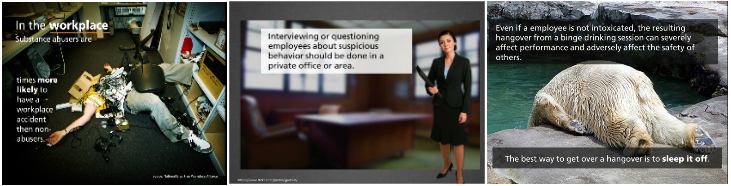
athandtraining.com screenshot

Resources:

Download a free DOT Reasonable Suspicion Checklist here

Where Can You Find the DOT Supervisor Training Regulations?

Where Can You Find the DOT Supervisor Training Regulations?

Right here! Save yourself the Google searching…

Here’s a summary of, and links to, the federal website for the of the DOT supervisor training requirements for reasonable suspicion supervisor training by regulatory agency:

Federal Motor Carrier Safety Administration (FMCSA) – 49CFR Part 382.603

§ 382.603: Training for supervisors.

Each employer shall ensure that all persons designated to supervise drivers receive at least 60 minutes of training on alcohol misuse and receive at least an additional 60 minutes of training on controlled substances use. The training will be used by the supervisors to determine whether reasonable suspicion exists to require a driver to undergo testing under § 382.307. The training shall include the physical, behavioral, speech, and performance indicators of probable alcohol misuse and use of controlled substances. Recurrent training for supervisory personnel is not required.

Federal Aviation Administration (FAA) – 14 CFR Part 121 Append I & J

Drug Testing: Testing Based on Reasonable Cause. Each employer must test each employee who performs a safety-sensitive function and who is reasonably suspected of having used a prohibited drug. The decision to test must be based on a reasonable and articulable belief that the employee is using a prohibited drug on the basis of specific contemporaneous physical, behavioral, or performance indicators of probable drug use. At least two of the employee’s supervisors, one of whom is trained in detection of the symptoms of possible drug use, must substantiate and concur in the decision to test an employee who is reasonably suspected of drug use; except that in the case of an employer, other than a part 121 certificate holder, who employs 50 or fewer employees who perform safety-sensitive functions, one supervisor who is trained in detection of symptoms of possible drug use must substantiate the decision to test an employee who is reasonably suspected of drug use.

Alcohol Reasonable Suspicion Testing: 2. The employer’s determination that reasonable suspicion exists to require the covered employee to undergo an alcohol test shall be based on specific, contemporaneous, articulable observations concerning the appearance, behavior, speech or body odors of the employee. The required observations shall be made by a supervisor who is trained in detecting the symptoms of alcohol misuse. The supervisor who makes the determination that reasonable suspicion exists shall not conduct the breath alcohol test on that employee.

Federal Transit Administration (FTA) – 49 CFR 655

655.14 Education and training programs.

Each employer shall establish an employee education and training program for all covered employees, including:

(a) Education. The education component shall include display and distribution to every covered employee of: informational material and a community service hot-line telephone number for employee assistance, if available. (b) Training—(1) Covered employees. Covered employees must receive at least 60 minutes of training on the effects and consequences of prohibited drug use on personal health, safety, and the work environment, and on the signs and symptoms that may indicate prohibited drug use. (2) Supervisors. Supervisors and/or other company officers authorized by the employer to make reasonable suspicion determinations shall receive at least 60 minutes of training on the physical, behavioral, and performance indicators of probable drug use and at least 60 minutes of training on the physical, behavioral, speech, and performance indicators of probable alcohol misuse.

Pipeline and Hazardous Materials Safety administration (PHMSA)

Drug Testing: (d) Testing based on reasonable cause. Each operator shall drug test each employee when there is reasonable cause to believe the employee is using a prohibited drug. The decision to test must be based on a reasonable and articulable belief that the employee is using a prohibited drug on the basis of specific, contemporaneous physical, behavioral, or performance indicators of probable drug use. At least two of the employee’s supervisors, one of whom is trained in detection of the possible symptoms of drug use, shall substantiate and concur in the decision to test an employee. The concurrence between the two supervisors may be by telephone. However, in the case of operators with 50 or fewer employees subject to testing under this part, only one supervisor of the employee trained in detecting possible drug use symptoms shall substantiate the decision to test.

Alcohol Testing: §199.241  Training for supervisors. Each operator shall ensure that persons designated to determine whether reasonable suspicion exists to require a covered employee to undergo alcohol testing under §199.225(b) receive at least 60 minutes of training on the physical, behavioral, speech, and performance indicators of probable alcohol misuse.

U.S. Coast Guard (USCG) – §16.250   Reasonable cause testing requirements.

(a) The marine employer shall require any crewmember engaged or employed on board a vessel owned in the United States that is required by law or regulation to engage, employ or be operated by an individual holding a credential issued under this subchapter, who is reasonably suspected of using a dangerous drug to be chemically tested for dangerous drugs.

(b) The marine employer’s decision to test must be based on a reasonable and articulable belief that the individual has used a dangerous drug based on direct observation of specific, contemporaneous physical, behavioral, or performance indicators of probable use. Where practicable, this belief should be based on the observation of the individual by two persons in supervisory positions.

Supervisors must be given at least sixty minutes of training.

Federal Railroad Administration (FRA) – §219.300 Mandatory reasonable suspicion testing.

(a) Requirements. (1) A railroad must require a covered employee to submit to an alcohol test when the railroad has reasonable suspicion to believe that the employee has violated any prohibition of subpart B of this part concerning use of alcohol. The railroad’s determination that reasonable suspicion exists to require the covered employee to undergo an alcohol test must be based on specific, contemporaneous, articulable observations concerning the appearance, behavior, speech or body odors of the employee.

(2) A railroad must require a covered employee to submit to a drug test when the railroad has reasonable suspicion to believe that the employee has violated the prohibitions of subpart B of this part concerning use of controlled substances. The railroad’s determination that reasonable suspicion exists to require the covered employee to undergo a drug test must be based on specific, contemporaneous, articulable observations concerning the appearance, behavior, speech or body odors of the employee. Such observations may include indications of the chronic and withdrawal effects of drugs.

(b)(1) With respect to an alcohol test, the required observations must be made by a supervisor trained in accordance with §219.11(g). The supervisor who makes the determination that reasonable suspicion exists may not conduct testing on that employee.

(2) With respect to a drug test, the required observations must be made by two supervisors, at least one of whom is trained in accordance with §219.11(g).

AtHand Training provides awesome online training for DOT Supervisor for reasonable suspicion training.  

Use the buttons below to purchase and get compliant right now! 

credit cards accepted


Buy DOT Supervisor Course – $37

Buy DOT Employee Drug Awareness Course $10


Signs and Symptoms of Adderall Use in the Workplace

Signs and Symptoms of Adderall Use in the Workplace

adderall_03

The use of the psychostimulant amphetamine Adderall is again on the rise. Due to its ability to increase attention and concentration it has become the drug of choice among the college crowd and those looking to gain a competitive edge in sports, the classroom, and in the workplace.  In fact, the demand for Adderall became so dramatic in 2012 that the federal government had to act to combat shortages of the drug.

It stands to reason that use of Adderall in the university would carry over into the workplace as students graduate and find themselves in yet another competitive environment. Quest Diagnostics, the nation’s largest toxicology laboratory reported in their 2014 Drug Testing Index Report that for the first time in 10 years the positivity rate for workplace drug testing increased and attributed it to “a rise in marijuana and amphetamines (use)” and things look to be getting worse. The proliferation of the drug can be reliably tracked by simply looking at the amount produced each year. Since the drug is classified as a schedule II drug, yearly production is controlled by the DEA.  In 1990, 417 kg of amphetamine was produced; in 2012 the number was 25,300 kg. The number is doubling every few years.

Safety risks and other problems of use in the workplace

If Adderall helps performance and concentration, what’s the big deal? Here’s a few reasons…

Employee health:

  • Loss of appetite can cause stress and malnutrition
  • Sleep deprivation and physical exhaustion
  • Paranoia and psychosis
  • Can be highly addictive
  • Withdrawal symptoms – extreme agitation, irritability and (ironically) an inability to focus
  • Long term use can cause anhedonia, or the inability to feel a sense of enjoyment or pleasure without the aid of some chemical stimulant
  • Increased violent behavior
  • Possibility of overdose – hallucinations, convulsions and possible death

Productivity and Safety: Any short-term increases on concentration and productivity are simply outweighed by the potential negative effects on the employees physical and mental health. Even with the perceived good intentions, Adderall abusers, especially those performing safety sensitive duties pose a significant risk to their selves, their co-workers and possibly the public. In addition, long-term users will find that the benefits they thought they were receiving from use disappear as they become sleep deprived, overworked, exhausted and unfocused. As with other stimulants, users may develop a need to take larger doses over time to receive the same effect further worsening their problem.

Adderall in the workplace

Since the drug is available by valid prescription it is possible that employees will have a legitimate prescription for Adderall. However because the drug is so easy to come by it is very likely that many employees would be abusing the drug without prescription. The difference in dealing with employee with a prescription and an employee without prescription is beyond the scope of this post, however any supervisor with the authority to make a reasonable suspicion determination should review their workplace drug policy, and have a good understanding of state and federal law as it relates to prescription drug use. There’s a good article written in OHS (Occupational Health and Safety) .

Companies with employees performing safety sensitive duties such as driving a DOT regulated vehicle, flying a plane, driving a bus, working with hazardous materials, etc. need to be extra vigilant in their efforts to ensure employees exhibiting signs and symptoms of use or abuse are interviewed and possibly drug tested when necessary.

Signs and Symptoms

When looking for signs and symptoms of Adderall abuse supervisors should be looking for ‘deviations from the norm’ in the employees typical behavior, attitudes and physical characteristics.  For example, if an employee is exhibiting an elevated level of alertness and excitement but has always historically exhibited those characteristics then those particular signs and symptoms would be a weak indicator of use. You looking for signs that would be abnormal for that individual.

Stimulation:

Alertness | Highly Energetic | Abnormal Level of Confidence |  Reduced Apeitite | Raised Pulse | Rapid Breathing | Over Excitement | Dry Mouth | Pupil Dilation | Abnormally Talkative | Sweating | Restlessness | Irritability | Anxiety | Aggression | Coordination Difficulty | Headaches

Withdrawal:

Physical Exhaustion | Depressed Mood | Sleepiness | Mood Swings | Over Sleeping | Depression | Anxiety | Irritability

Addiction:

Paranoia | Delusions | Hallucinations | Severe Anxiety | Poor Judgement | Depression | Suicidal Thoughts | Exhaustion | Weight Loss | Malnutrition

 AtHandTraining.com provides online training for DOT supervisor training, DOT employee drug awareness training, and drug free workplace drug and alcohol awareness training.

 credit cards accepted


Buy DOT Supervisor Course

Buy DOT Employee Drug Awareness Course

Buy DFWP Supervisor Course

Buy FAA Recurring Course